
Sankofa: Five Ancestors Guiding Our Path to Food Sovereignty
By: Mykalee McGowan
Edited by: Onyx Ramírez
This blog post contains the personal opinions and reflections of the author and is not representative of the voice of the organization.
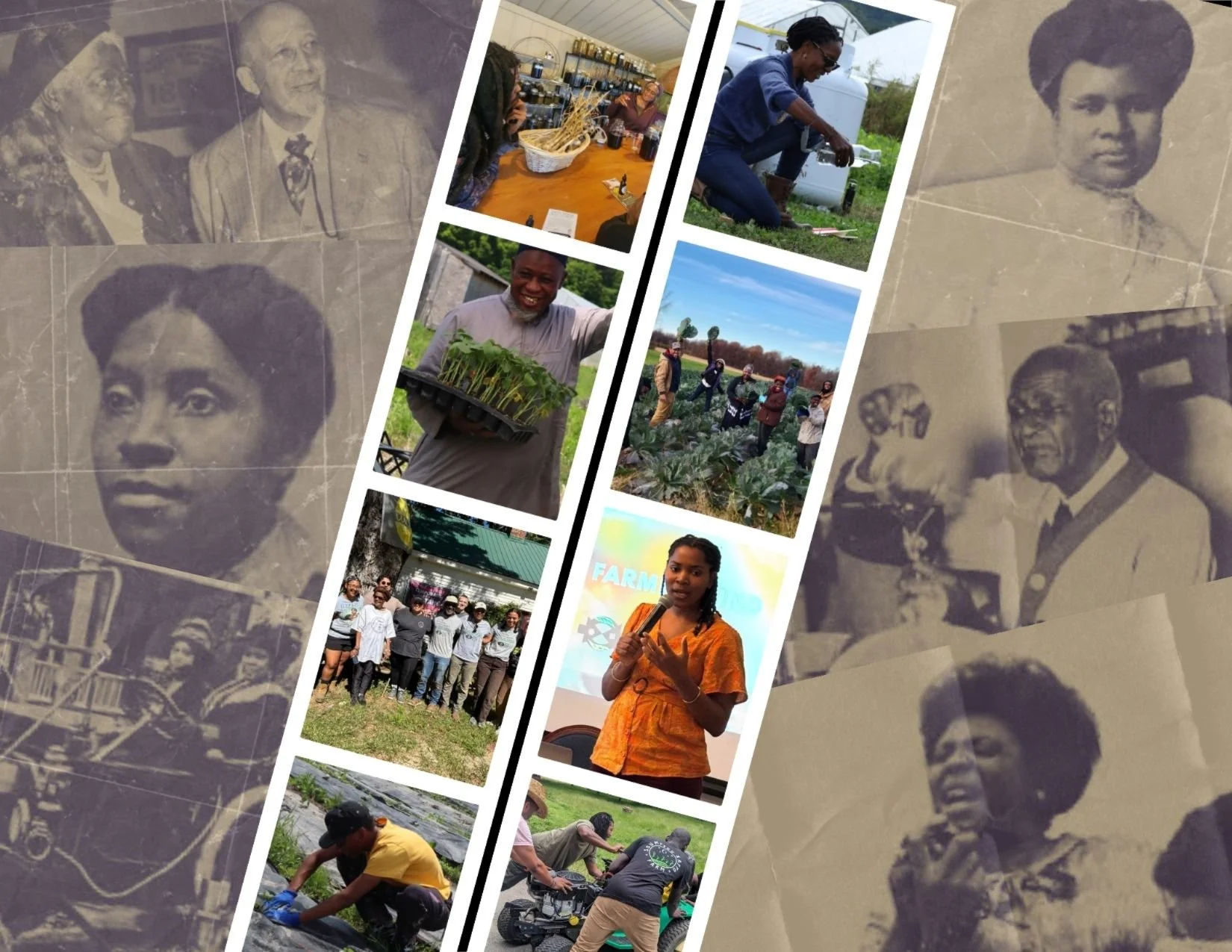
Photo Collage: Mykalee McGowan

By Mykalee McGowan, Communications Associate at Black Farmer Fund
Sankofa /ˈsɑn.kɔ.fə/ — Go back and get it.
Sankofa is an adinkra symbol that originated from the Akan people of Ghana. Commonly represented by a bird looking backwards or a stylized heart, it derives from the Akan proverb, “Se wo were firi na wosan kofa, yenkyiri” and means "It is not taboo to go back and get something after you have forgotten it".
I first encountered Sankofa as a college freshman at an HBCU, a completely new world for me, as a 1st generation Caribbean-American who was largely raised in the white suburbs of eastern Pennsylvania. From my very first week, I was immersed in the history, philosophies, and innovations of Black people and learning Black cultures and traditions beyond my own.
One idea that surfaced time and time again was that honoring your ancestors is more than remembering them — it’s listening, learning, and building upon the legacy they left behind. That ethos showed up in everything we did, from hosting a Black History Month Wikipedia Edit-a-thon to studying historical community organizing strategies to plan student protests.
My college experience deepened my understanding of ancestry and led me to explore my own lineage. Learning about my ancestors' lives, the lessons they carried, and the many stories they held has shaped how I move in the world. Their wisdom has informed my choices, their practices have sustained me, and their legacy has given me the confidence to know that I descend from vibrant, strong, and transformative people.
Black Farmer Fund (BFF) carries that same understanding. Grounded by the wisdom and legacy of our ancestors, BFF leans on the experiences of past activists, food and agricultural leaders, radical thinkers, and community changemakers to help guide our work towards building a thriving Black agricultural system. Here are five revolutionary ancestors whose legacies continue to shape what we do.
1. Fannie Lou Hamer
Born in 1917, Fannie Lou Hamer was the youngest of 20 children to cotton sharecroppers in rural Mississippi. Growing up in the post reconstruction era, Hamer grew up navigating brutal realities of Jim Crow from dealing with racial discrimination and poverty to experiencing forced sterilization.
In 1962, she attended a voting rights meeting hosted by the Student Non-Violent Coordinating Committee (SNCC) that ignited her activism journey. With the SNCC, she registered thousands of Black Americans to vote and led relief efforts such as distributing food and clothes to communities in need.
Her community organizing work increased her public profile and made her a target to racial violence. Nevertheless, she persevered and expanded her organizing work to the political stage.
In 1964, she co-founded the Mississippi Freedom Democratic Party (MFDP) and represented the party in that year’s Democratic National Convention. Her powerful testimony boosted support for the Voting Rights Act, which later passed in 1965.
That same drive to create systemic change nationwide led her to return home and create economic change in her own community. In 1968, Fannie Lou Hamer founded the Freedom Farm Cooperative in Sunflower County, Mississippi. The cooperative grew from 40 acres to a thriving 680 acre operation, supporting over 1,500 Black families through farming, housing development, and educational programs. For over 5 years, the cooperative singlehandedly created food security and economic sufficiency for the majority of the county residents.
At Black Farmer Fund, Fannie Lou Hamer inspires our approach to building community power. Her legacy of grassroots organizing and collective action continues to inform our programming, from virtual skillshares to community workdays.
2. Callie House
Born enslaved in Rutherford County, Tennessee in 1861, Callie House's early life was shaped by the harsh realities of post-Civil War America. She married William House at 22 and together they raised five children. After his death, she supported her family as a washerwoman serving both Black and white patrons. In search of better economic opportunities, she relocated to Nashville in the 1890s, a move that would set the course of her life's work.
In her new South Nashville community, she encountered a pamphlet titled Freedmen’s Pension Bill: A Plea for American Freedmen. It discussed reparations, the concept of financial compensation to rectify the past exploitation of slavery. Intrigued, Callie House joined the pro-reparations movement and partnered with fellow activist, Reverend Isaiah Dickerson to charter the National Ex-Slave Mutual Relief, Bounty and Pension Association (MRBPA) in 1897.
The organization pursued two goals: advocating for federal reparations legislation and providing mutual aid benefits to formerly enslaved people, including financial assistance, burial expenses, and legal aid. House and Dickerson traveled throughout the South to build support, and by 1900 House had taken the helm of an organization with over 300,000 members nationwide.
Callie House’s reparations advocacy and mutual aid efforts inspired the collective decision making process in our investment model. Her impact is proof that when people are heard and supported collectively, real change becomes possible.
3. W.E.B. DuBois
Born on February 23, 1868 in Great Barrington, Massachusetts, William Edward Burghardt "W.E.B." Du Bois showed exceptional intellectual promise from an early age. Encouraged by his mother, he became the first in his family to attend high school, graduating as valedictorian in 1884 and even writing articles for the New York Globe and the Freeman along the way.
With financial support from friends, family, and community members, he went on to attend Fisk University in Nashville, Tennessee. It was in Nashville where DuBois, a northerner, observed the stark difference of the subtle racial discrimination he experienced in Massachusetts compared to the harsher realities of racism and violence in the South and how segregation influenced these outcomes.
In 1888, W.E.B. DuBois graduated from Fisk University but his academic career doesn’t stop there. He earned a second bachelor's degree from Harvard in 1890, a master's in History in 1891, and in 1895 became the first Black man to earn a PhD from Harvard. His dissertation, “The Suppression of the African Slave Trade to the United States of America, 1638 - 1870,” became his first book and a staple of historic and social analysis of American history.
He went on to produce The Philadelphia Negro in 1899, a landmark study of Black urban life, and The Souls of Black Folk in 1903, which introduced the concept of double consciousness and established him as one of the foremost thinkers on the Black American experience.
In 1910, W.E.B. DuBois became the editor of The Crisis, NAACP’s monthly magazine. There, he drew attention to lynching and pushed for federal legislation to outlaw the widespread murderous practice. Under his guidance the magazine had increased in readership and support for the organization as it became the prime publication covering Black culture and race relations in the nation.
W.E.B. Du Bois’ work on economic self-determination is a cornerstone of Black Farmer Fund’s mission. His belief that education and economic development are essential tools for Black liberation continues to guide how we show up for our community.
4. George Washington Carver
Born into slavery around the early 1860s in Diamond, Missouri, George Washington Carver's earliest years were marked by tragedy and resilience. As an infant, he was kidnapped by slave raiders along with his mother and sister. Unfortunately, only George was recovered.
Orphaned, he was raised by white farmer and slave owner, Moses and Susan Carver, who taught him to read and write and nurtured his natural curiosity. From a young age, George showed a remarkable gift for plants, experimenting with natural pesticides, fungicides, and soil conditioners and earning the nickname "the plant doctor" from local farmers whose fields he helped restore.
Driven by his passion for learning, George left the farm at 11 and spent the next decade traveling and working his way through school. Despite having his college acceptance rescinded by Highland College once they discovered he was Black, he pressed on and enrolled at Simpson College in Iowa, which admitted all qualified applicants. His professor, Etta Budd, recognized his passion for plants and encouraged him to transfer to the Iowa State Agricultural School for botany. This educational pivot led him to become the first African American to earn a Bachelor of Science degree in 1894.
In 1896, he accepted a job offer from Booker T. Washington to join Tuskegee Institute, where he would spend the rest of his career. There, Carver made huge strides in the US agricultural field by:
Inventing the Jesup wagon, a mobile classroom and laboratory, so he can travel from farm to farm and demonstrate soil chemistry.
Introducing crop rotation techniques to restore soil depleted by constant cotton planting by growing nitrogen rich plants like peanuts, soybeans, and sweet potatoes.
Promoting the use of compost to revitalize the soil instead of commercial fertilizer that provided short term gains but released harmful chemicals into the soil if used long term.
Developing numerous products from the surplus of non-cotton crops including over 300 peanut based products.
George Washington Carver's deep connection to the land influences BFF’s own commitment to land stewardship and support with food and agricultural business that uses regenerative and sustainable environmental practices. He teaches us that working in harmony with the land can build lasting knowledge, health, and wealth for everyone. By supporting these organizations and spreading the word, you can help ensure that undocumented Latinx farmworkers have the tools they need to thrive.
5. madame cj walker
Born Sarah Breedlove in 1867, Madam C.J. Walker overcame poverty and other adversities to build a successful business empire. After experimenting with various herbs and treatments to address her own hair loss, she developed a groundbreaking line of hair care products specifically designed for Black women and founded the Madam C.J. Walker Manufacturing Company. Her vision and determination propelled her to become the first self-made African American female millionaire in the United States.
Beyond her business accomplishments, Walker was a devoted philanthropist and social justice advocate. She used her wealth and platform to uplift African American communities, champion women's empowerment, and invest in causes that created lasting change.
At Black Farmer Fund, her legacy is a powerful reminder that true success is measured not only by what we build, but by how we use it to serve others.
Sankofa reminds us that looking at our past is an intentional step to create a brighter future. Fannie Lou Hamer, Callie House, W.E.B. DuBois, George Washington Carver, and Madam C.J. Walker not only made momentous strides when they lived but left behind paved roads and master blueprints for future generations to build upon.
So go back and get it. Go back to the land, to the community, to the traditional practices, to our stories, and like our ancestors, leave behind a better world than you inherited.
Sources:
Agbo, A. H. (2025). Values of Adinkra symbols.
American Experience, PBS. (2014, June 25). Fannie Lou Hamer. American Experience | PBS. https://www.pbs.org/wgbh/americanexperience/features/freedomsummer-hamer/
Boyd, H. (2022, January 30). The Rev. Isaiah Dickerson, a relentless advocate for reparations. New York Amsterdam News. https://amsterdamnews.com/news/2021/06/17/rev-isaiah-dickerson-relentless-advocate-reparatio/
Early, R. (2021). The Sweat and Blood of Fannie Lou Hamer. Humanities, 42(1). https://www.neh.gov/article/sweat-and-blood-fannie-lou-hamer
Fannie Lou Hamer founds Freedom Farm Cooperative - SNCC Digital Gateway. (2021, September 24). SNCC Digital Gateway. https://snccdigital.org/events/fannie-lou-hamer-founds-freedom-farm-cooperative/
George Washington Carver | Scientist, inventor, and teacher video. (2026, February 13). [Video]. PBS LearningMedia. https://whyy.pbslearningmedia.org/resource/americon-vid-george-w-carver/video/
George Washington Carver National Monument, & Robbins, P. (2008, February 1). About GWC: a tour of his life. https://web.archive.org/web/20080201171906/http://www.nps.gov/archive/gwca/expanded/gwc_tour_01.htm
Harder, C. F. (2024, October 17). African American Herbalism, Part 2: North American Black Herbalism. Chestnut School of Herbal Medicine. https://chestnutherbs.com/african-american-herbalism-part-2/
History.com Editors. (2009a, October 27). George Washington Carver: facts, inventions & more. https://www.history.com/articles/george-washington-carver#Early-Life
History.com Editors. (2009b, October 27). W. E. B. du Bois - Beliefs, Niagara Movement & NAACP. https://www.history.com/articles/w-e-b-du-bois
How Fannie Lou Hamer challenged a nation. (2024, April 16). National Museum of African American History and Culture. https://nmaahc.si.edu/explore/stories/how-fannie-lou-hamer-challenged-nation
Kwabena, N. (2025, August 22). Sankofa. Adinkra Symbols & Meanings. https://www.adinkrasymbols.org/symbols/sankofa/
McMillian, A. (2019, September 10). Research guides: W. E. B. du Bois: A resource Guide: Introduction. https://guides.loc.gov/web-dubois
Michals, D., PhD (Ed.). (2017). Biography: Fannie Lou Hamer. National Women’s History Museum. https://www.womenshistory.org/education-resources/biographies/fannie-lou-hamer
NAACP. (2021, May 11). W.E.B. du Bois. https://naacp.org/find-resources/history-explained/civil-rights-leaders/web-du-bois
The legacy of Dr. George Washington Carver. (2024, October 11). National Centers for Environmental Information (NCEI). https://www.ncei.noaa.gov/news/legacy-dr-george-washington-carver
Walker, E. J. (2026, January 26). Callie House fought for reparations over 100 years ago. The Black Wall Street Times. https://theblackwallsttimes.com/2022/10/04/callie-house-fought-for-reparations-over-100-years-ago/