
Earth Day: A Call To Communal Action for Food Sovereignty
By: Jeanne D’arc Koffi
This blog post contains the personal opinions and reflections of the author and is not representative of the voice of the organization.

By Jeanne D’arc Koffi, Communications Intern at Black Farmer Fund
Living in a capitalist country, which boasts the world’s largest economy, means contending with the fact that our principal modes of production exploit the natural resources and environment around us in unsustainable and degrading ways. Earth Day is a reminder to remain vigilant of the ways in which ecocide* has become a quintessential part of the United States’ industrial systems, which prioritize profit and corporate interests over the well-being of the earth and its communities. As an inhabitant of this land, I contribute to its stewardship by finding ways to leverage against the large corporations that are waging war against our home. One of the entry points that I use to consider my impact is by thinking through my actions as a consumer in our agrifood* systems. To give a concise overview, our agrifood supply chain operates within a consolidated network, in which farmers face concentrated markets for the inputs they use to produce their commodities, the markets into which they sell, and the processing and manufacturing retailers available to them (Hendrickson et al., 2019). Firms dealing in inputs such as fertilizer, seed, and livestock genetics, farm machinery, and agrichemicals have particularly undergone extensive mergers over the past decades.
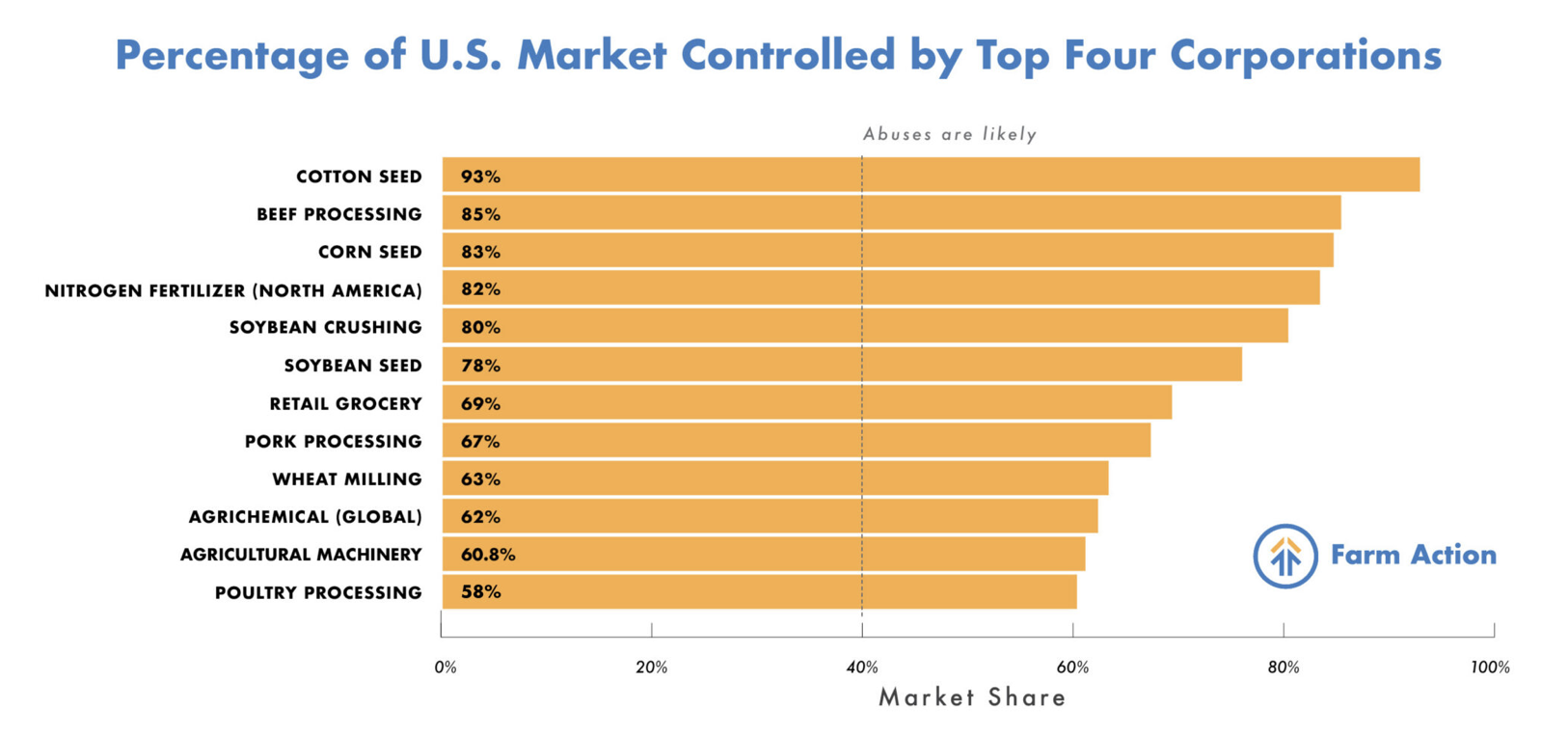
Only a handful of dominant companies, in each respective sector, are estimated to control significant portions of their markets (Lakhani et al., 2022). When the number of companies that sell these materials, which have been made necessary, shrinks and becomes concentrated across a handful of firms, supply chain disruptions can prove catastrophic. However, what’s most adversely affected on a daily basis is the amount of “choices that farmers can make about how they treat their land, animals, and workers, and even what kind of farming they decide to enter.”
This consolidation of power enables transnational agrifood firms to organize production infrastructure in ways that are most economically beneficial to them, rendering farmers dependent on products such as proprietary seeds and accompanying fertilizer, herbicide, and pesticide packages. Moreover, the narrow categories of crops that our farmers are incentivized to grow by our government, and through lobbying by large agri-corporations, reflect this concentrating effect and reinforce the reliance on fossil fuel-derived chemical inputs, whose production releases greenhouse gases, and their use remains one of the primary drivers of biodiversity loss. Chronic exposure to pesticides “is linked to cancer, reproductive harm, and neurological disorders.” and specifically disproportionately affects BIPOC communities in rural and low income areas. The available research indicates that BIPOC and low wealth communities are primarily exposed to higher volumes of pesticides than the total population at large, with one study identifying that African Americans and Mexican Americans tend to have “higher concentrations of pesticide biomarkers in their blood or urine than non-Hispanic whites who don’t live in poverty.” Yet still, industrial-scale monocultures through the proliferation of commodity crops such as corn and soybeans, whose primary uses are for livestock feed, biofuel, and to make cheap sugars, starches, and oils that end up in highly processed junk foods, dominates our domestic farming operations; along with the corresponding use of ‘protective technologies’ to maintain yield and manage pests.
Commodity crops are therefore also inextricably linked to the use of concentrated/Confined Animal Feeding Operations (CAFOs), also known as factory farms, where 99 percent of our livestock is mass produced under revolting conditions. These farms are known to generate staggering amounts of waste with just one farm capable of producing “more feces and urine than an entire city.” They also emit high quantities of toxic pollutants through our air and waterways, causing illnesses as well as water contaminations, and are disproportionately located near rural, and/or low-income and “under-resourced [Black and other communities of color] in North Carolina, Iowa, and California’s Central Valley — all areas in which CAFOs are densely concentrated.” The firms which manage the processing of this livestock also function as an oligopoly and have been numerously accused of squeezing farmers and ranchers while increasing prices for consumers.
All of this damaging industrial activity, engineered by consolidated industries, is a signal that we need to pay closer attention to. The fact that our current primary agricultural practices degrade our ecologies and reduce biodiversity, threatening the very resources on which our food production depends, should alarm and compel us to transform what’s considered to be mainstream farming in this country. The ways in which the agricultural monopolies around us are amassing power should not be confused for the organizing of an efficient and functioning system, especially when so many Black and Brown communities across the country are being subjected to systems of food apartheid.
What we currently have is a fragile, precarious, and exploitative food network, which must be transitioned into a decentralized, diverse, and interconnected food system that can prove resilient against the ecological challenges ahead. We must restore our relationship to food and agriculture through the proliferation of community gardens, food and farm Co-ops, and technological infrastructures to expand farming approaches guided by principles such as regenerative agriculture and agroecology. At the heart of all the possible solutions on the table should be an insistence on producers’ rights, localized food systems, ecological sustainability, and seed sovereignty.
On this Earth Day, I am thinking deeply about ways in which we can collectively advance towards and achieve food sovereignty within our communities. Through my experience as an intern with the Black Farmer Fund, I have learned a lot about the role of Black farmers in this vision and why our support of their work is significant. Moreover, my belief is that we must connect with and support our producers of color because our futures are interwoven. The work of building and strengthening regional, sustainable agricultural systems requires that we each critically assess the circumstances in our specific localities and identify how we can best contribute.
Sources:
Cappiello, J. (2023, October 7). The Meat Industry Hurts BIPOC Communities. Here’s How. World Animal Protection US. https://www.worldanimalprotection.us/latest/blogs/meat-industry-hurts-bipoc-communities-heres-how/
Earthjustice. (2023, January 17). Over Fifty Groups Petition EPA to Improve Oversight of Water Pollution from Concentrated Animal Feeding Operations - Earthjustice. https://earthjustice.org/press/2022/over-fifty-groups-petition-epa-to-improve-oversight-of-water-pollution-from-concentrated-animal-feeding
Farm Action. (2026, April 14). Agriculture Concentration Data | Farm Action. https://farmaction.us/concentrationdata/
FarmAdmin, & FarmAdmin. (2025, May 12). Behind the Brands: The Meatpacking Monopoly and the Illusion of Choice | Farm Action. Farm Action. https://farmaction.us/behind-the-brands-the-meatpacking-monopoly-and-the-illusion-of-choice/
Garza, F., & Garza, F. (2024, August 21). Here’s how much cropland could be freed up if Americans ate half as much meat. Grist. https://grist.org/food-and-agriculture/heres-how-much-cropland-could-be-freed-up-if-americans-ate-half-as-much-meat/
Hendrickson, M. K. (2020). Covid lays bare the brittleness of a concentrated and consolidated food system. Agriculture and Human Values, 37(3), 579–580. https://doi.org/10.1007/s10460-020-10092-y
Hendrickson, M. K., Howard, P. H., & Constance, D. H. (2019). Power, food, and Agriculture: In University of Nebraska Press eBooks (pp. 13–62). https://doi.org/10.2307/j.ctvgs0crb.7
La Via Campesina. (2025, November 12). What is Food Sovereignty? La via Campesina - EN. https://viacampesina.org/en/what-is-food-sovereignty/
Lakhani, N., Uteuova, A., & Chang, A. (2022, November 5). Revealed: the true extent of America’s food monopolies, and who pays the price. The Guardian. https://www.theguardian.com/environment/ng-interactive/2021/jul/14/food-monopoly-meals-profits-data-investigation#:~:text=We%20found%20that%20for%2085,shelves%20stacked%20with%20different%20boxes.
Levy, J. (2025, July 2). IPES Report Exposes Food System Links to Fossil Fuels and Proposes Solutions. Food Tank. https://foodtank.com/news/2025/07/ipes-report-exposes-food-system-links-to-fossil-fuels-and-proposes-solutions/
Mengistie, B. T., Ray, R. L., & Iyanda, A. (2025). Environmental and Human Health Impacts of Agricultural Pesticides on BIPOC Communities in the United States: A Review from an Environmental Justice Perspective. International Journal of Environmental Research and Public Health, 22(11), 1683. https://doi.org/10.3390/ijerph22111683
Ritchie, H. (2025, February 13). Almost all livestock in the United States is factory-farmed. Our World in Data. https://ourworldindata.org/data-insights/almost-all-livestock-in-the-united-states-is-factory-farmed
Rushing, K., & Rushing, K. (2026, March 31). North Carolina Communities’ Battle Against Animal Factory Pollution. Earthjustice. https://earthjustice.org/article/north-carolina-communities-battle-against-animal-factory-pollution