
Black Queer Farmers: Growing Through Adversity
By: Onyx Ramírez and Mykalee McGowan
This blog post contains the personal opinions and reflections of the author and is not representative of the voice of the organization.
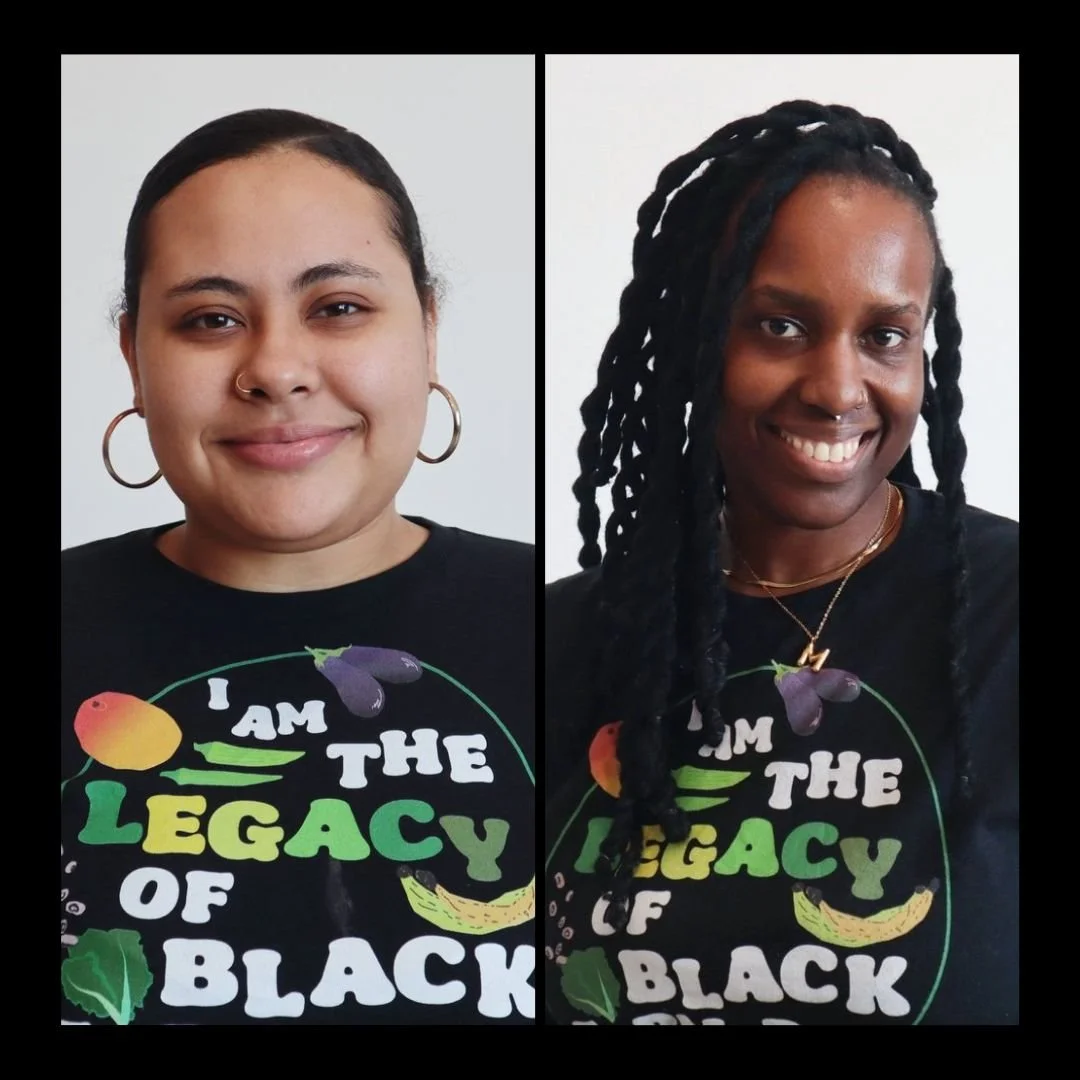
By Onyx Ramírez and Mykalee McGowan, Senior Communications Manager and Communications Associate, Black Farmer Fund
From federal program cuts to price inflation, U.S. agricultural producers are struggling to grow and sustain their businesses. This is particularly the case for Black Queer farmers, who navigate a farming system shaped by racial, economic, and social inequities. According to the National Young Farmer Survey, 63.5 percent of young farmers in the United States are not cis men and 24.2 percent identify with some type of queer identity.
These farmers sit at the intersection of both Black and queer communities, making the barriers they face all the more urgent to understand and address. In this article, we explore four key challenges Black Queer farmers face and highlight the five organizations dedicated to supporting them through community building efforts, advocacy, resource sharing, and fighting for a more inclusive food system.
Challenges Black Queer Farmers Face
1.Lack of Representation
Every five years, The US Department of Agriculture’s National Agricultural Statistics Service conducts a census of farmland and farming communities. Due to the omission of diverse gender and sexuality options, the survey fails to accurately capture BIPOC and Queer land stewards. The data is used to create programs and resources to boost the US agricultural industry. However, the lack of representation of Black Queer land stewards hinders them from receiving those resources. Outside of the agriculture census survey, there’s little research done in academia that shows us the experience and challenges of Black Queer farmers.
2.Racism, Homophobia, and Transphobia
While the US congress is still deciding on the Equality Act, there are only 23 states, Washington D.C., and Puerto Rico that have laws that explicitly prohibit discrimination against LGBTQIA+ people in employment, housing, and public accommodations as of 2024 (Human Rights Campaign, 2025). Additionally, 701 anti-trans bills were introduced in federal and state legislatures that same year alone (2024 Anti-Trans Bills: Trans Legislation Tracker, 2025).
Despite the work done in protests and Capitol Hill, shifting the agricultural industry into an inclusive space will take some work. There are many stories of Black Queer farmers feeling isolated and unsafe in white-owned farms. Current exclusionary and toxic farm workplaces have turned many marginalized farmers away from the field.
3.Lack of Community
For Black Queer land stewards who have their own farming operations or have the capital to start, they have to consider their location. According to a report by the Movement Advancement Project, five percent of rural Americans identify as LGBTQIA+, with only 20 percent of that population being a person of color.
With 97 percent of American farms being family-owned, adequate communal support is necessary for smaller Black Queer-owned farms to flourish in business and wellbeing.
4.Lack of Resources
In many ways, the agricultural industry remains a boys' club, as markets and policies continue to favor White male farmers. According to the academic article, “Surveying Queer Farmers”, it is shown that systemic heteropatriarchal oppression in the farming field has created obstacles for queer farmers to gain resources such as profitability, land access, health insurance, and affordable housing (Hoffelmeyer et al., 2023).
Organizations Supporting Black Queer and LGBTQIA+ Farmers
The compounding weight of these challenges makes clear that systemic change cannot happen in isolation. Across the country, a growing number of organizations are building networks, safe spaces, and essential resources that Black and LGBTQIA+ farmers need to grow and thrive. Here are five organizations leading the way.
1.Queer Farmer Network
The Queer Farmer Network (QFN) is a not-for-profit grassroots organization of current and aspiring farmers, gardeners, growers, caretakers of land, food revolutionaries, and more. The QFN was formed in 2018 by a group of comrades in the upper midwest as a support resource for queer farmers that would help build community & combat isolation among rural and queer farmers, while interrupting heteropatriarchal, capitalist, and racist legacies in agriculture.
2.Trans Farmers 4 Trans Farmers
Trans Farmers 4 Trans Farmers is building a dynamic community of trans people farming in the US and beyond. Focused on support, connection, and resiliency of land and body, they invite all trans farmers to join them.
A place of support and community for trans people farming, they have a Discord group, resources, and a fabulous zine with creative works from over 20 trans farmers!
3.Not Our Farm
Not Our Farm (NOF) is a non-profit farmworker storytelling project that strives to celebrate and share the stories of non-owning workers on farms. We aim to increase visibility around the challenges and abuses that happen on farms, regardless of the size, location, or reputation.
NOF is building power among farmworkers by cultivating a virtual place of community in which farmworkers share their stories and skills, create resources, and form relationships with each other. Their “All the Farm’s a Stage” fellowship is a four month storytelling opportunity for QTBIPOC farmworkers, culminating in a virtual performance and virtual multimedia exhibit.
4.Queer Food Foundation
The Queer Food Foundation’s mission is to be a nationwide resource and platform for LGBTQIA+ individuals in food. The Queer Food Foundation is devoted to promoting, protecting, and funding queer food spaces. From farmworkers, sommeliers, media experts to waitstaff, brewers, and gardeners, the Queer Food Foundation hopes to fill the gap, to begin creating a platform for queer expression in food, to advocate for more inclusive food industry spaces, and to offer all queer food workers a space to build, meet, and speak about their experiences.
5.Rock Steady Farm
Rock Steady Farm is a Queer and Trans-led cooperative vegetable farm & nonprofit rooted in social justice, food access and farmer training. Rock Steady Farm grows culturally meaningful foods, trains Queer, Trans, Black, Indigenous, and People of Color (QTBIPOC) farmers, and catalyzes structural and political change in the food system.
Through its various farmer training and support programs, Rock Steady Farm is disrupting and addressing the web of interconnected systemic barriers QTBIPOC farmers are facing through training and supporting QTBIPOC farmers and their ventures.
Pride began as a protest by Black and Brown Queer people demanding justice and equity for their community. That spirit of Resistance is still alive in Black Queer farmers and the organizations that support them.
Including us, we at Black Farmer Fund believe that Black LGBTQIA+ land stewards deserve safe and inclusive spaces and opportunities to connect to the land, nourish their communities, and make a profit that sustains their business and themselves.
It is wonderful to see we are not alone, as the five organizations highlighted here shows that change is already underway. This Pride season and beyond, we encourage you to follow, support, and amplify Black Queer farmers and the organizations that uplift them.
Sources:
2024 Anti-Trans Bills: Trans Legislation Tracker. (n.d.). https://translegislation.com/bills/2024
Ackoff, S., Flom, E., García Polanco, V., Howard, D., Manly, J., Mueller, C., Rippon-Butler, H., Wyatt, L., Caceres, Y., Foster West, E., Obodozie, L., Un, K., University of Wisconsin Survey Center, & SJ Brekosky. (2022). Building a Future With Farmers 2022: Results and recommendations from the National Young Farmer Survey. In National Young Farmers Coalition. https://www.youngfarmers.org/wp-content/uploads/2022/08/NationalSurveyReport2022.pdf
Guha, N., & Borek, S. (2024, November 24). Queer farmers are working to transform our food systems — and paying a price. Truthout. https://truthout.org/articles/queer-farmers-are-working-to-transform-our-food-systems-and-paying-a-price/
Human Rights Campaign. (2025, April 29). The Equality Act. HRC.org. https://www.hrc.org/resources/equality
Hoffelmeyer, M., Wypler, J., & Leslie, I. S.(2023). Surveying queer farmers: How heteropatriarchy affects farm viability and farmer well-being in U.S. agriculture. Journal of Agriculture, Food Systems, and Community Development. Advance online publication. https://doi.org/10.5304/jafscd.2023.123.005
Mok, A. (2023). Queer, BIPOC Farmers are Working for a More Inclusive and Just Farming Culture. Civil Eats. https://civileats.com/2021/04/01/queer-bipoc-farmers-are-working-for-a-more-inclusive-and-just-farming-culture/
Quinn, L. (2024, June 27). First of its kind study shines light on LGBTQ+ farmer mental health | College of Agricultural, Consumer & Environmental Sciences | Illinois. ACES News. https://aces.illinois.edu/news/first-its-kind-study-shines-light-lgbtq-farmer-mental-health
Velasquez, D. (n.d.). We grow where we go: LGBTQ+ farmers put down roots. Green America. Retrieved June 2, 2023, from https://www.greenamerica.org/voices-inclusion-and-justice/we-grow-where-we-go-lgbtq-farmers-put-down-roots